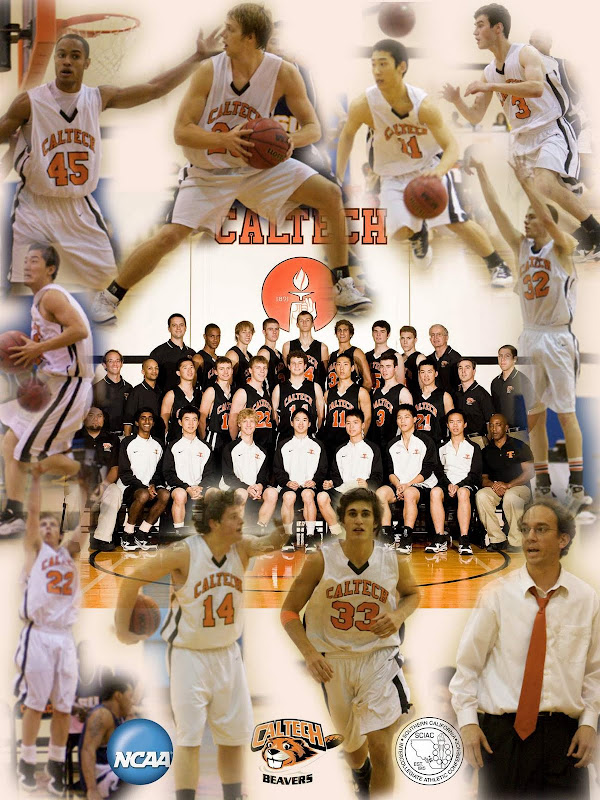
Monday, July 12, 2010

Beavers Bounce into Honors Court

Four Caltech players from the 2009-10 season were recently named to the NABC Honors Court for their achievements in the classroom. Honorees include ZeNan Chang, Christian Clanton, Ryan Elmquist, and Ruslan Kurdyumov.

Chang (biology), Clanton (applied physics), and Kurdyumov (mech E and business econ mgmt) graduated in June and are headed to graduate school while Elmquist is a rising senior and computer science major.

Both Clanton and Kurdyumov are 2-time honorees.

For the full list and official release from the NABC, click here. (Caltech student-athletes appear on page 3).


(From the release)

KANSAS CITY, Mo. — The National Association of Basketball Coaches (NABC) today announced the NABC Honors Court, recognizing those collegiate basketball student-athletes who excelled in academics during the 2009-10 season. The NABC Honors Court recognizes the talents and gifts that these men possess off the court, and the hard work they exhibit in the classroom. In order to be named to the Honors Court, an athlete must meet a high standard of academic criteria. The qualifications are as follows:

1. Academically a junior or senior and a varsity player.

2. Cumulative G.P.A. of 3.2 or higher at the conclusion of the 2009-10 academic year.

3. Students must have matriculated at least one year at their current institution.

4. Member of an NCAA Division I, II, III, or NAIA Institution.

Friday, June 25, 2010

Movin' On: Leibowitz Lands Dream Job

Jeremy Leibowitz, a 2010 graduating senior, was hired as a quantitative analyst at Rimrock Captial Management based in San Juan Capistrano, Calif. A fixed income hedge fund, Rimrock Capital is 60 miles southeast of Pasadena.

His dual degree in applied computational mathematics and business, economics, management will surely be put to good use.

"This is my dream job," announced Leibowitz, just a few days prior to his graduation ceremony. "I am going to be learning all about the bond market ... I will be building mathematical models and analyzing individual bonds."

Leibowitz, who hails from Las Vegas, was a 4-year member of the basketball team and served as a captain this past season. In his last game as a senior, he hauled in 11 rebounds and recorded 3 steals. Though he battled health issues much of his career, Leibowitz -- the Caltech Outstanding Freshman Athlete in his first year -- maintained his commitment and devotion to the basketball program. He was instrumental in helping to develop younger players on and off the court, and was -- and will continue to be -- a main cog in the recruitment of future student-athletes.

After an arduous season of interviews, Leibowitz finally found what he wanted.

"I'll be living by the beach," said Leibowitz. "I'm pretty excited."

Monday, June 14, 2010

The Yang Way: Engineering a Jump Shot

by Yang Yang, Caltech class of 2009

Periodically, CxB3 presents posts by alumni and friends of Caltech Basketball. Mr. Yang graduated from Caltech in 2009 with a degree in Biology. While playing basketball for the Beavers, he also served as a contributing writer to The Tech, the campus newspaper.


"…basketball has become - at its best - the paramount synthesis in sport of intelligence, precision, courage, audacity, anticipation, artifice, teamwork, elegance, and grace."
- Carl Sagan, The Demon-Haunted World

Missing a shot during a basketball game is fairly common. With the exception of power forwards and centers who do their damage from within ten feet, most players shoot less than 50 percent from the field. Even great players struggle to make more shots than they miss. Michael Jordan only did that in six of the 15 seasons he played, finishing with a career average of 49.7 percent. To paraphrase Jeff Van Gundy, the NBA is a mostly miss league. If a circus knife thrower had that kind of accuracy… well, let's just say it wouldn't be a kid-friendly show. So why can circus performers fling knives 30 feet across the room to hit an apple above someone's head with high accuracy, but NBA players struggle to guide a basketball 30 feet across the court into a hoop?

Well, that's not a completely fair comparison. No circus knife thrower has to deal with a defender trying to intercept the knife or obstructing his vision. When dealing with pure shooting with no defense, basketball players are actually pretty amazing. Former Caltech guard Fred Newman holds the world record for 3-pointers made in a row with 209. Don't believe me? Check out the two-hour long video (cut version; uncut version, part 1). If that doesn't impress you, he also can make 88 free throws in a row while blindfolded. Still, whether it's Fred taking his 210th shot of that morning or Ray Allen taking a shot anytime during Game 3 of the 2010 NBA finals, players will miss.

Why?

Ask that question to an engineer, the answer will be mainly about suboptimal trajectories; ask a neuroscientist, it will be all about stability and precision of neural networks; and when you ask a psychologist, the reply will focus on mindset.

There are biological limits to accuracy - even when muscles are stimulated with the same voltage shock, there will be some variability in the output of force. When gauging distance, we will always make estimation errors.

To an engineer, shooting a basketball is just about solving equations. The mathematical laws which guide the trajectory of a basketball are well known. Lobbing an object into the air to hit a distant target has interested the military for millennia. Whether it's catapults, trebuchets, cannons or howitzers, armies for the past thousand years have used machines to bombard enemies from afar. It's a problem siege engineers have solved countless times in the past. In a simplified model, there are only two variables to consider - horizontal and vertical speed of the ball. Because we are constantly subject to the downward pull of gravity, we need an initial upward velocity to ensure the ball stays airborne. Once we know how long something can stay airborne from the initial vertical velocity, it's easy enough to calculate how fast its horizontal speed must be in order to reach the target. Introductory physics classes have tortured students with these problems for decades.

Unfortunately, accurately describing a basketball's motion requires much more detail than just the simple setup above. The collision of the ball with the rim will transfer some kinetic energy, depending on velocity and angle. This will affect the direction, speed and spin of the ball. With each collision, the spin of the ball will also influence all ball-to-surface contact, since it modulates the amount of friction between the two objects. In order to really describe real motion, we need a set of equations which considers all these factors and their simultaneous effects on each other. (A good mathematical summary can be found here). In fact, it is much easier to write a computer simulation which follow these rules and just run millions of iterations.

(to be continued)

Tuesday, June 8, 2010

Big Math in Finals

Want some intriguing discussion on the cataclysmic chance that a Phil Jackson team will lose a playoff series after winning the first contest? Turn to the brilliant math folks at Caltech:

Are you telling me that if the Lakers win in the opener Thursday night at Staples Center, the Celtics aren't going to be peppered with that number [47-0] for the next two weeks? And that at least some of it isn't going to stick?

"I know when I go to the free-throw line, the odds of me missing one grow if I haven't missed one in a while,'' Boston's Ray Allen said with a grin. ''So I'll think of it like that.''

The Celtics act like the number is a coincidence. Smarter people than both of us say it is not ... I decided that, yes, I should consult with someone from the brainiest university in the country.

So I called the folks from Caltech.

A couple of grad students in applied and computational mathematics —Stephen Becker and Mike McCoy — figured that the odds of going 47-0 by coincidence were less than three in a billion.

''I would be demoralized if I were the other team,'' Becker said.

Gary Lorden, a Caltech professor emeritus in mathematics, added, ''If I were a huge basketball fan and ran into this stat, I would say, wow.''

Thursday, May 27, 2010

Tech Trails: Beavers Ride Wave to More SURFs

Tech Trails tracks summer plans of Caltech basketball players -- from SURFs (summer undergraduate research fellowships) to related work in the fields of math, science, and engineering.

Two more players will be SURFing this summer on campus. (artwork by Caltech tennis player Michelle Jiang '11)

Arjun Chandar, a freshman guard from Miami, Florida, will be researching Modern American politics and Christianity under Erik Snowberg. The project aims to investigate the factors that lead Christian preachers to deliver political sermons in modern times (since 1995).

Chandar, who is often referred to as "Mr. President" by the the team because of his leadership and communication skills, will be collecting sermons from church websites and classifying them as political or nonpolitical based upon the results of a computer program as well as manual inspection -- of course, he will write the program.

"I expect to learn more about programming and important political drivers in modern American culture," said Chandar. "Hopefully, my research can shed some light on how politics influences Christianity and, possibly, how Christianity can influence politics."

Chandar, along with fellow classmate Ethan Boroson, was voted Citizen of the Year this past season by teammates.

Ziying Wang, a junior guard from SoCal's Rowland Heights, is set to research Nano-scale chemistry application in atrophic age-related macular degeneration with Robert Grubbs, who won the Nobel Prize in chemistry in 2005. End-stage atrophic age-related macular degeneration is a disease that causes middle-aged and elderly patients to go blind.

"The goal of my research," said Wang, "is to come up with nano-particle systems that can potentially replace some of the dead ganglion cells' photoreceptors to return vision to the patient."

Wang is a 3-year player and a double major in chemistry and BEM (business economics management).

Monday, May 24, 2010

Edwards and Elmquist Honored by Caltech

Congratulations to Mike Edwards and Ryan Elmquist. Mike was named Freshman Male Athlete of the Year and Ryan was recognized as Outstanding Male Athlete of the Year at Caltech's Annual All-Sports Awards Show on Saturday.

Both Edwards and Elmquist ranked among the best in the SCIAC and set myriad records this season.

Click here for the official release.

Tuesday, May 18, 2010

Tech Trails: Freshmen Propelled to JPL

Tech Trails tracks summer plans of Caltech basketball players -- from SURFs (summer undergraduate research fellowships) to related work in the fields of math, science, and engineering.

Three more first-year basketball players will be working at the Jet Propulsion Laboratory this summer.

Mike Edwards (18.8 ppg, 3.7 rpg, 1.5 apg, 1.8 spg) will have a role in developing new platinum-based alloys for use in hydrogen-air fuel cells. He will also have his own sub-project while collaborating with a group of students on the main assignment.

"I expect to learn how to perform a modified sputtering system for preparing thin films," said Edwards, a mechanical engineering major. "I'm very excited to get a chance to work at JPL."

Collin Murphy (3.8 ppg, 4.1 rpg, 2.0 apg, 1.4 spg) has an internship working with instruments for Mars missions.

"This is my first glimpse into practical applications for my major," said Murphy, who is studying bioengineering. "Working at JPL will also give me a chance to continue working with really smart and experienced people throughout the summer."

Pan Wang (3.0 ppg, 1.7 rpg), an electrical engineering major, will be involved in a highly structured SURF under Steve Chien of JPL, entitled Onboard automated processing of SAR data for autonomous unpiloted vehicles and autonomous spacecraft.

Wang will investigate and implement approaches for transforming SAR data into readable images and study their accuracy in comparison to other satellite imaging. These algorithmic procedures will take SAR data and create classification maps or statistical summaries like soil-moisture estimations, glacial surges, fire-scars, and forest biomass.

"Essentially, I'll gain experience turning raw data into programmable data," explained Wang.

The concentration will be on approaches that can be efficiently implemented onboard autonomous aircraft or spacecraft so that vehicles operated by UAVSAR and DESDynI can engage in onboard automated processing of data.

"It will be great to work with a new group of scientists," said Wang.